Accident type · California
Freeway and Highway Accidents
High-speed crashes on the 5, 10, 15, 91, 405 and other state routes. CHP has jurisdiction.
Updated . General information, not legal advice about your situation.
Legal review: Elham Azimy, California State Bar No. 207274 (law and claims only).
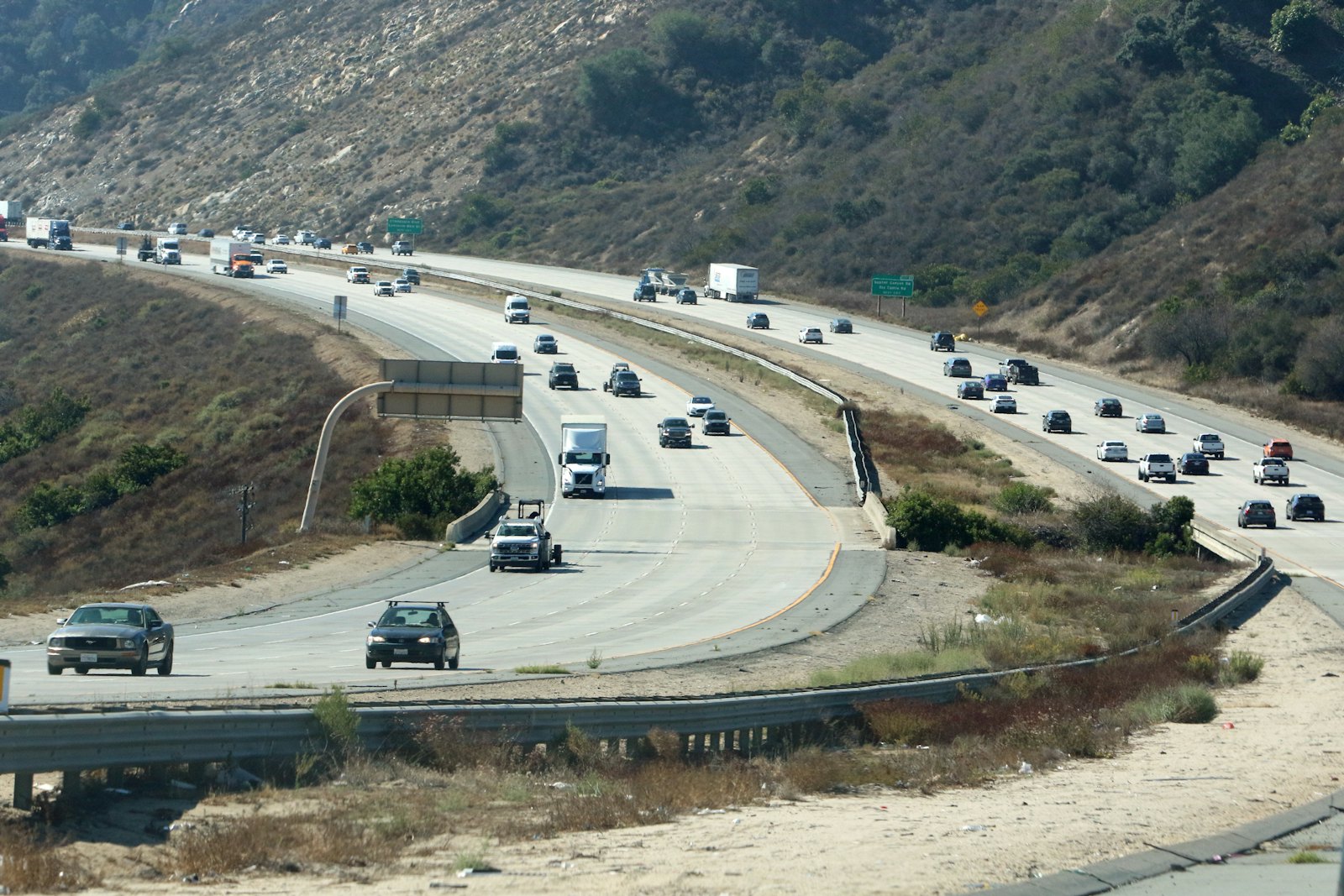
California’s freeways carry more traffic than any comparable network in the country, and crashes on them differ from city-street collisions in important ways: speeds are higher, the California Highway Patrol rather than local police investigates, multiple vehicles are often involved, and the location is frequently a stretch of road that is well known to engineers and investigators as a problem.
Who investigates a freeway crash
The CHP has jurisdiction over all state highways and freeways, including the ramps, regardless of which city the freeway passes through. A crash on the I-405 in Irvine is a CHP matter, not an Irvine Police Department matter. CHP divides California into area offices (for example, Santa Ana, Westminster, Capistrano, Central Los Angeles, West Los Angeles, Riverside, Temecula, Rancho Cucamonga, San Bernardino, Victorville, San Diego, Oceanside, El Cajon and Ventura), and the report is held by the office whose unit responded.
To obtain a CHP collision report, submit form CHP 190 (Application for Release of Information) to the area office, with identification and the report number or date and location. Reports generally take 7–10 business days or longer when follow-up investigation is required. See how to get a police report.
California’s most crash-prone freeway segments
Caltrans and regional agencies track collision concentrations through SWITRS data and the Transportation Injury Mapping System. Segments that recur in those analyses and in local reporting include:
- The SR-91 through Corona and the Santa Ana Canyon toward Anaheim Hills.
- The I-405 through the Sepulveda Pass and the Irvine–Costa Mesa stretch, including the El Toro Y.
- The I-5 through the Anaheim Resort district and through downtown Santa Ana.
- The SR-57/SR-60 shared segment in Diamond Bar and Pomona.
- The I-10 through the San Bernardino Valley logistics corridor and the I-10/I-15 interchange in Ontario.
- The I-15 through the Cajon Pass.
- The I-710 between the ports and the I-405.
- The I-5/I-805 merge in Sorrento Valley and the I-8 through Mission Valley in San Diego.
These are patterns, not predictions about any individual crash. The relevance to a claim is practical: congestion, weaving and known hazards shape what a reasonable driver should have anticipated.
Common freeway crash scenarios
- Rear-end collisions in stop-and-go traffic, often involving several vehicles.
- Sideswipes during lane changes at interchanges and express-lane entries.
- Truck collisions on the logistics corridors.
- Secondary collisions when drivers strike vehicles stopped from an earlier crash.
- Collisions with debris, disabled vehicles or construction zones.
- Wrong-way and impaired-driving crashes late at night.
Evidence specific to freeway crashes
Caltrans operates traffic cameras and loop detectors along major freeways, and the Performance Measurement System (PeMS) records speeds and flows that can corroborate congestion at the time of a crash. Toll transponder records on the 91, 73, 133, 241, 261 and 125 express lanes establish location and time. Trucks carry electronic logging devices and often forward- and driver-facing cameras. Much of this evidence is retained only briefly and requires prompt written preservation requests.
Construction zones and Caltrans
Major projects—the I-5 North in Burbank, the I-405 in Orange County, the I-10 and I-15 express lanes in San Bernardino County—change lane configurations frequently. A crash caused by negligent work-zone design or maintenance may support a claim against Caltrans or its contractor; claims against Caltrans require a government claim within six months (Government Code § 911.2). Double fines apply to violations in work zones.
After a freeway crash
- Get off the roadway.
If the vehicle is drivable, move to the right shoulder or the next exit; standing in or near traffic lanes after a crash is a frequent cause of fatalities. California’s “move over” law (§ 21809) requires passing drivers to slow and move over for stopped emergency vehicles.
- Call 911 and report your location by freeway, direction and nearest exit or call box.
- Photograph what you safely can, including the other vehicles’ plates and the lane positions.
- Ask the CHP officer for the report number and the area office.
- File the SR-1 with the DMV within 10 days if there was injury or more than $1,000 in damage.
Common questions
CHP did not come to our crash on the freeway. Can I still get a report?
If there were no injuries and vehicles were moved, CHP may not respond. You can file a counter report at the area office afterward, and you must still file the SR-1 with the DMV. Insurance claims can proceed on your documentation and the other driver’s information.
I was in a secondary crash caused by an earlier collision blocking lanes. Who is responsible?
Potentially the drivers in the first crash if they negligently created the hazard, and the driver who struck you if they failed to slow for a visible hazard. These claims involve multiple insurers and careful reconstruction.
Does the freeway’s known congestion excuse a driver who rear-ended me?
No. Known congestion makes sudden stops foreseeable, which strengthens the duty to maintain a safe following distance.
Describe what happened. Attorney Elham Azimy reviews every inquiry personally and, if we can help, calls you to talk it through. Free evaluation; no fee unless we recover for you.
Sources and official resources
- California Highway Patrol — find an office
- California Highway Patrol — collision report requests (CHP 190)
- CHP Statewide Integrated Traffic Records System (SWITRS)
- UC Berkeley SafeTREC Transportation Injury Mapping System (TIMS)
- Government Code § 911.2 (six-month claim deadline against public entities)
- Caltrans QuickMap (real-time conditions)
Links go to official government, court and public-health sources. Laws change; verify current text before relying on it.